Mixing Hydroponic Nutrients: EC, pH, and Common Mistakes

What a Hydroponic Nutrient Solution Actually Is
Think of a hydroponic nutrient solution as a configuration file for plant growth. In soil, a complex ecosystem of bacteria, fungi, and organic matter buffers nutrient availability; the plant negotiates with the soil. In hydroponics, the roots are bathed directly in water with dissolved mineral salts, and there is no buffer layer. Whatever you put in the reservoir is what the plant gets.
That dissolved mineral cocktail needs to supply all 17 essential plant nutrients:
- Macronutrients (primary): Nitrogen (N), Phosphorus (P), Potassium (K)
- Macronutrients (secondary): Calcium (Ca), Magnesium (Mg), Sulfur (S)
- Micronutrients: Iron (Fe), Manganese (Mn), Zinc (Zn), Copper (Cu), Boron (B), Molybdenum (Mo), Chlorine (Cl), Nickel (Ni), Cobalt (Co), Silicon (Si), Selenium (Se)
Soil grows typically run a deficit on one or two micronutrients and compensate through soil biology. Hydroponics exposes every gap immediately. Miss iron and your new leaves yellow within a week. Miss calcium and you get tip burn on lettuce or blossom-end rot on tomatoes.
The precision is the point. You are not hoping the soil has what the plant needs; you are specifying exactly what goes in and measuring the result. That is also why the mixing sequence matters: do it wrong and some of those minerals precipitate out of solution before the plant can absorb them.
What You Need Before You Start
Do not start mixing until you have these on hand:
Meters (non-negotiable):
- EC/TDS meter: measures total dissolved solids; this is your primary feedback tool. Budget meters from Apera or BlueLab work fine.
- pH meter: a cheap pH pen from Amazon is adequate for small systems. Calibrate it with 4.0 and 7.0 buffer solutions monthly.
Adjustment solutions:
- pH Down: typically phosphoric acid. Small drops, big effect.
- pH Up: potassium hydroxide or potassium silicate. Add even more slowly.
Nutrient concentrate: A 3-part system like General Hydroponics FloraGrow / FloraMicro / FloraBloom gives the most flexibility to adjust ratios across growth stages. Jack’s Nutrients 321 (two-part) is popular with growers who want simplicity without sacrificing completeness. Masterblend 4-18-38 plus calcium nitrate is common in commercial operations. Any of these work; what matters is that you follow their specific mixing order, because the chemistry is different.
Calibration solutions: Buy the buffer packets that came with your pH meter. EC calibration fluid at 1.41 mS/cm is standard. Calibrate before your first mix and again whenever readings seem off.
Water source: Distilled or RO water is the cleanest starting point because EC reads 0.0: you know exactly what you are adding. Tap water is fine for most growers. Measure your tap water’s baseline EC before adding anything. If it reads above 0.5 mS/cm, factor that into your target.
EC Targets by Crop and Stage
EC (electrical conductivity) is measured in mS/cm (millisiemens per centimeter). Higher EC means more dissolved nutrients. Different crops have different appetites, and those appetites change through the growth cycle.
| Crop | Seedling EC | Vegetative EC | Fruiting / Mature EC |
|---|---|---|---|
| Lettuce | 0.8–1.0 | 1.2–1.8 | 1.6–2.0 |
| Basil | 0.8–1.0 | 1.0–1.6 | 1.2–2.0 |
| Tomatoes | 1.0–1.2 | 2.0–2.5 | 2.5–3.5 |
| Peppers | 1.0–1.2 | 2.0–2.5 | 2.5–3.0 |
| Spinach | 0.8–1.0 | 1.2–1.6 | 1.4–1.8 |
| Microgreens | 0.8–1.0 | 1.0–1.2 | (harvest before mature) |
A few notes on reading this table:
Seedlings and young transplants are sensitive to salt stress. If you plant into a reservoir at full vegetative EC, you risk burning the roots before they can adapt. Start low, ramp up.
Tomatoes at fruiting want a surprisingly high EC: 2.5 to 3.5 mS/cm triggers the plant to produce more concentrated, flavorful fruit. Running tomatoes at lettuce EC (1.2–1.8) gives you watery fruit and slow ripening.
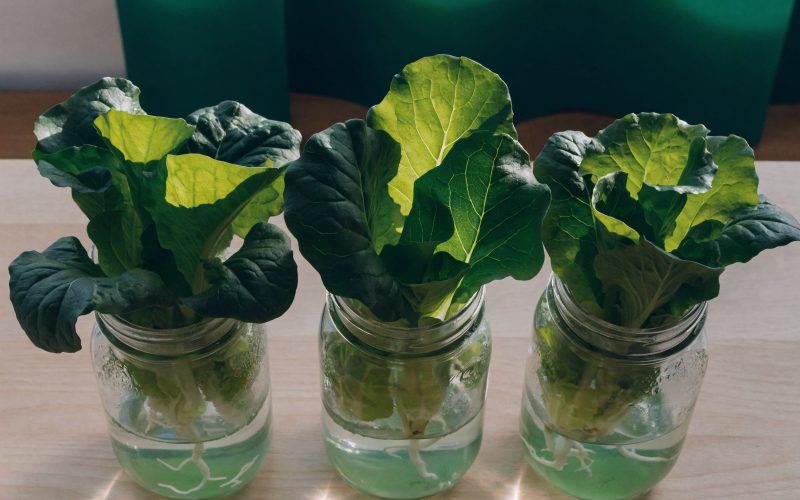
Lettuce in warm weather can benefit from slightly lower EC, around 1.0–1.4, because it grows faster and tip burn risk increases with higher salt concentration. Whether you are running a Kratky jar or a DWC bucket, the crop’s appetite, not the system, sets the target.
The Correct Mixing Sequence
This is where most beginners make irreversible mistakes. The sequence is not arbitrary; it prevents two chemistry problems: precipitation and inaccurate pH readings.
Here is the correct order, step by step:
Step 1: Start with clean water
Pour your base water into the reservoir or mixing bucket. Measure and record the starting EC. Tap water often reads 0.2–0.5 mS/cm depending on your municipal supply. This baseline gets subtracted from your target when calculating how much nutrient to add.
If you are using tap water, you can let it sit uncovered overnight to off-gas chlorine. Chloramine (the alternative disinfectant many municipalities use) does not off-gas; neutralize it with a tiny amount of vitamin C (ascorbic acid) or sodium thiosulfate, available at homebrew shops.
Step 2: Add Part A (calcium-containing component) and stir
For 3-part systems (FloraGrow/FloraMicro/FloraBloom), FloraMicro is the calcium-containing part and goes in first. Always add to the water, not the other way around. Stir until fully dissolved; you should see no cloudiness. Let the pump run for 30 seconds if your reservoir has one.
The reason this must go first: calcium ions (Ca²⁺) need to be well-distributed in the water before you introduce phosphate ions (PO₄³⁻). If they meet at high concentration, as they would if you mixed two concentrates together before diluting, they instantly form calcium phosphate (Ca₃(PO₄)₂), a white precipitate that sinks to the bottom and is no longer available to the plant. You lose both calcium and phosphorus from your solution without knowing it.
Step 3: Add Part B and stir
For GH Flora series, FloraGrow goes in second. Stir again. EC should be rising. If it is not moving at all, your meter battery may be dead.
Step 4: Add Part C and stir
FloraBloom last. Stir thoroughly. The solution should be clear or very slightly tinted. Cloudiness means precipitation has occurred; drain, clean, and start over with better mixing sequence.
Step 5: Measure EC and compare to target
Check the EC against your crop-and-stage target from the table above. If you are short, add more nutrients in the same ratio. If you overshot, add plain water to dilute. Do not try to correct with pH solution; you have not added that yet.
Step 6: Adjust pH, always last
This is the most common mistake: adding pH adjustment before nutrients are fully dissolved. pH adjustment changes the charge balance of the solution, which affects the dissolved form of nutrient ions. If you adjust pH first, then add nutrients, the pH shifts again anyway and you have wasted solution.
Add pH Down or pH Up in small increments, 1 mL at a time for reservoirs under 10 gallons. Stir, wait 30 seconds, re-measure. Repeat until you land in the 5.8–6.2 range. For most crops, 6.0 is the optimal midpoint. Do not chase a specific decimal; anywhere in 5.8–6.2 is fine.
Why 5.8–6.2? Each nutrient has a pH window where it exists in the ionic form roots can absorb. Iron is most available below 6.5. Calcium and phosphorus availability drops sharply below 5.5. The 5.8–6.2 window maximizes availability across the full nutrient spectrum.
Working With Tap Water
Most tap water works fine for hydroponics and you do not need to invest in an RO system to get started. The important variables to know:
Baseline EC: Measure it before adding anything. If your tap reads 0.3 mS/cm and your target is 1.6 mS/cm for vegetative lettuce, you are adding nutrients until you reach 1.6 total, not 1.3 above baseline. The EC meter reads the total, not just what you added.
Water hardness: Hard water has high concentrations of calcium and magnesium carbonate. If your tap is very hard (above 200 ppm hardness), you may not need to add as much calcium and magnesium from your nutrient concentrate. Watch for symptoms of magnesium deficiency (interveinal chlorosis on older leaves) as a signal that hardness is not covering your Mg needs.
Chlorine vs. chloramine: Standard chlorine off-gasses overnight. Chloramine does not. Call your water utility or check their annual water quality report online to find out which disinfectant they use. Chloramine at the levels found in municipal water will not immediately kill plants, but it inhibits root zone bacteria and can stress plants over long grows. Neutralize with a pinch of ascorbic acid (vitamin C); a quarter teaspoon treats 10 gallons.
pH of tap water: Tap water pH varies widely, from 6.5 to 8.5 depending on municipality. Add nutrients first, then adjust. Do not try to pre-adjust tap water pH before mixing nutrients; it will shift dramatically when you add the concentrate.
pH Management After Mixing
Once your nutrients are in and EC is at target, pH adjustment is your final step and your ongoing maintenance task.
Adjusting down (lowering pH): pH Down is concentrated phosphoric acid. A few drops make a noticeable difference. Add 1 mL at a time to reservoirs under 5 gallons, 2–3 mL for 10-gallon systems. Stir, wait 30 seconds, re-measure. Overshooting pH down is common; it creates an oscillation where you add down, overshoot, add up, overshoot again. Go slow.
Adjusting up (raising pH): pH Up is typically potassium hydroxide (KOH) or potassium silicate. Even more potent per drop than pH Down. Use half the amount you think you need, stir, re-measure. Potassium silicate has the added benefit of strengthening cell walls and adding silica to the solution, which is a real micronutrient benefit.
Natural pH drift: Even a well-mixed solution will drift. Plants release organic acids through their roots, CO₂ from root respiration forms carbonic acid, and nutrient uptake changes the ion balance. In an active DWC system, check pH every 24–48 hours and adjust as needed. A drift from 6.0 to 6.5 over two days is normal. A drop to 5.2 or a spike to 7.0 indicates something is wrong, usually a failing pump, dying roots, or a reservoir that needs changing. DWC reservoir management requires more frequent monitoring than passive systems like Kratky.
Monitoring: When to Top Off vs. Change
Your reservoir EC will naturally drift between changes. Here is how to interpret what it tells you:
EC rising: The plant is consuming water faster than nutrients. It is drinking but not eating proportionally, common in hot weather or when light intensity increases transpiration. Top off with plain water (no nutrients) to bring EC back to target.
EC dropping: The plant is consuming nutrients faster than water. This happens during rapid vegetative growth when demand for N is high. Top off with a dilute nutrient solution mixed to roughly half your target EC.
EC stable but pH drifting daily: Normal root metabolism. Just adjust pH. No need to change the reservoir.
Full reservoir change schedule:
- Leafy greens (lettuce, basil, spinach): every 7–14 days
- Fruiting crops (tomatoes, peppers): every 5–7 days, higher root mass, higher metabolite accumulation
- Microgreens: usually no change needed; they are harvested before significant drift occurs
Why change at all if you are topping off? Over time, even with top-offs, salts accumulate in ratios that no longer match what you mixed. Certain ions get consumed faster than others, leaving an imbalanced solution. A full change resets the system. Think of it as garbage collection: periodic rather than continuous, but essential.
Common Mistakes
1. Not measuring starting EC before adding nutrients
If your tap water reads 0.4 mS/cm and you add nutrients until your target reads 2.0 mS/cm, you have actually added 1.6 mS/cm worth of dissolved salts, which is correct. But if you assumed tap water was zero, you may have stopped adding at a lower EC, underfeeding your plants. Measure the baseline, always.
2. Adjusting pH before nutrients are fully dissolved
Nutrients change the pH of the solution. If you adjust pH first, then add your nutrient concentrate, the pH will shift, sometimes dramatically, and you will need to re-adjust anyway. Always nutrients first, pH last.
3. Not stirring between nutrient additions
Adding Part A, then immediately pouring Part B on top creates a high-concentration mixing zone where precipitation can occur even if the final diluted solution would have been fine. Stir or let the pump run for 30 seconds between each component.
4. Confusing PPM scales on your TDS meter
TDS meters convert an EC reading to PPM using a multiplication factor. The 500 scale multiplies EC by 500; the 700 scale multiplies by 700. A reading of 1,400 PPM on the 500 scale means EC is 2.8 mS/cm. The same solution on the 700 scale reads 1,960 PPM. If you are following a recipe in PPM without knowing which scale the recipe author used, you may be 40% off. Always confirm your meter’s scale, or convert everything to EC (mS/cm) which is unambiguous.
5. Repeated plain-water top-offs without periodic reservoir changes
Each plain-water top-off dilutes the solution slightly and restores volume. Over two weeks of only topping off, the nutrient ratios drift as different ions are consumed at different rates. The solution gets out of balance in ways EC alone will not show you. Stick to your full-change schedule.
6. Using softened water
Water softeners replace calcium and magnesium with sodium ions. Sodium is toxic to most plants at the concentrations found in softened water. Never use water from a water softener for hydroponics. Use the unsoftened cold tap line, or RO water.
A Worked Example: 5-Gallon DWC Reservoir for Lettuce
Here is exactly how I mix a 5-gallon DWC reservoir for lettuce from tap water, targeting vegetative EC of 1.6 mS/cm at pH 6.0.
Setup:
- 5-gallon bucket with air stone and air pump running
- General Hydroponics FloraSeries 3-part (FloraMicro, FloraGrow, FloraBloom)
- Apera pH-60 meter (calibrated this week)
- Bluelab Truncheon EC meter
- pH Down (GH General Purpose)
- Tap water, measured at baseline EC 0.3 mS/cm, pH 7.8
Mixing:
-
Fill bucket with 5 gallons of tap water. Air pump running. Record: EC 0.3 mS/cm, pH 7.8.
-
Consult GH Flora label for vegetative lettuce. Target: 5 mL FloraMicro + 10 mL FloraGrow + 5 mL FloraBloom per gallon for moderate feed. Scale to 5 gallons: 25 mL Micro, 50 mL Grow, 25 mL Bloom.
-
Add 25 mL FloraMicro to the water (not to the other concentrates). Stir. Wait 30 seconds with air pump running. EC reads approximately 0.8 mS/cm.
-
Add 50 mL FloraGrow. Stir. Wait 30 seconds. EC reads approximately 1.3 mS/cm.
-
Add 25 mL FloraBloom. Stir. Wait 30 seconds. EC reads 1.5 mS/cm. Close to target of 1.6; I will add a touch more FloraMicro and FloraGrow (5 mL each) to nudge up. Final EC: 1.6 mS/cm. Good.
-
Now pH. Current pH is 6.8 (nutrients brought it down from 7.8 but it is still above target). Add 3 mL pH Down. Stir. Wait 30 seconds. pH reads 6.3. Add 1 mL more. pH reads 5.9. Close enough; 5.8–6.2 is the target window, 5.9 is fine.
-
Final check: EC 1.6 mS/cm, pH 5.9. Fill reservoir, confirm pump and air stone are running, transplant or top up. Done.
Total time from water to reservoir-ready: about 12 minutes. The first time takes longer because you are calibrating your meters and reading labels. By the third mix, you have a feel for how much pH Down your tap water needs and can dial it in faster.
What to watch over the next 7 days:
- Day 2: Check pH. It may drift to 6.2–6.4 as roots establish. Adjust if above 6.5.
- Day 4: Measure EC. If it has risen to 1.8+, top off with 0.5 gallons of plain water.
- Day 7: Full EC and pH check. If pH is stable and EC is within 0.2 mS/cm of target, you can run another week. If EC has dropped below 1.2 or smells off, change the reservoir.
Scaling Up
For larger systems, the math scales linearly. A 50-gallon system gets 10× the nutrient amounts of a 5-gallon system. The important variable that changes with scale is how you manage that volume.
At 20+ gallons, manually mixing and adjusting becomes time-consuming. Two options:
Concentrate premix: Mix a 1-gallon jug of each nutrient part at 10× concentration, then dose from those jugs. Keeps you from measuring small volumes repeatedly. Clearly label and store away from light and heat.
EC dosing pumps: Peristaltic pumps connected to an EC controller automate nutrient addition as EC drifts down. Atlas Scientific, Bluelab, and Autogrow make controllers that will dose Part A and Part B independently and maintain EC within ±0.1 mS/cm. Automating nutrient monitoring with sensors is the next natural step once you have manual mixing dialed in.
At commercial scale, separate holding tanks for Part A and Part B prevent the concentration contact that causes precipitation. The same chemistry principle applies; you are just engineering around it with infrastructure rather than careful pouring.
Environmental control complements nutrient management: once your EC and pH are dialed in, VPD (vapor pressure deficit) becomes the next lever. Plants can only use nutrients as fast as they are transpiring water, and VPD controls that rate. Your growing medium choice also affects how nutrients are delivered to the root zone: coco coir, for example, has a native cation exchange capacity that interacts with calcium and magnesium differently than clay pebbles or rockwool.
The Takeaway
A hydroponic nutrient solution is not complicated chemistry. It is a small number of parameters, EC at target, pH in range, nutrients added in the correct sequence, that you can measure precisely and adjust quickly. The reservoir is a configuration file and EC is your primary log output.
Get a reliable EC meter and a calibrated pH meter before you touch a nutrient bottle. Follow the sequence: water first, Part A, Part B, Part C, then pH last. Know your crop’s EC target and the direction EC should move when something is off. Change the reservoir on a schedule, not just when it looks bad.
Everything else, nutrient brands, additives, dosing automation, is optimization on top of that foundation. Start simple, measure everything, and you will have the data to improve from there.
[ FAQ ]
Can I use any brand of hydroponic nutrients?
Yes, most reputable hydroponic nutrient brands work well. The key is whether they supply all 17 essential plant nutrients in available ionic form. General Hydroponics, Masterblend, Advanced Nutrients, and Jack's 321 are all proven. What matters more than brand is following the mixing sequence correctly and measuring EC against target rather than blindly following label rates, which are often set too high.
What is the difference between EC and PPM/TDS?
EC (electrical conductivity) measures how well a solution conducts electricity, expressed in mS/cm (millisiemens per centimeter). PPM (parts per million) and TDS (total dissolved solids) are derived from EC using a conversion factor, typically 500 or 700 depending on the meter manufacturer. A reading of 2.0 mS/cm equals roughly 1,000 PPM on the 500 scale or 1,400 PPM on the 700 scale. Always confirm which scale your meter uses, or you will misread your nutrient concentration by 40%.
How do I know if my plants are getting enough nutrients?
The most reliable signals are plant color, growth rate, and EC trend. Healthy plants in the right EC range have deep green leaves, consistent new growth, and no interveinal chlorosis. If EC is in range but plants look deficient, check pH: nutrient lockout from pH drift is the most common cause of apparent deficiency in hydroponics. Also check root health; brown, slimy roots indicate root rot, which blocks nutrient uptake regardless of solution quality.
What should I do if my nutrient solution smells bad?
A bad smell, sulfur, sewage, or rot, means bacterial or algal growth in the reservoir. Drain and clean the reservoir immediately with a 3% hydrogen peroxide solution, rinse thoroughly, and mix a fresh batch. To prevent recurrence: keep the reservoir light-tight (algae need light), maintain water temperature below 72°F (22°C), and consider adding beneficial bacteria products or a small amount of hydrogen peroxide (3mL of 3% per gallon) to your regular mix.
Is RO water necessary for hydroponics?
No, most tap water works fine. RO (reverse osmosis) water is helpful if your tap water has an EC above 0.5 mS/cm, very high sodium, or inconsistent mineral content, all of which complicate dialing in the right nutrient ratios. If your tap water runs 0.1–0.4 mS/cm, just account for that baseline EC when mixing and you will be fine. If you are starting out, skip the RO filter and just let tap water sit overnight to off-gas chlorine before mixing.
Related Articles
VPD Chart for Plants: How to Read It and Control Humidity
Learn what vapor pressure deficit is, how to read a VPD chart, and what ranges to target at each plant growth stage to optimize growth and prevent mold.
Hydroponic Growing Media: Rockwool vs. Coco vs. Clay vs. Perlite
Compare the four main hydroponic growing media, rockwool, coco coir, clay pebbles, and perlite, with a decision matrix for your system and crops.